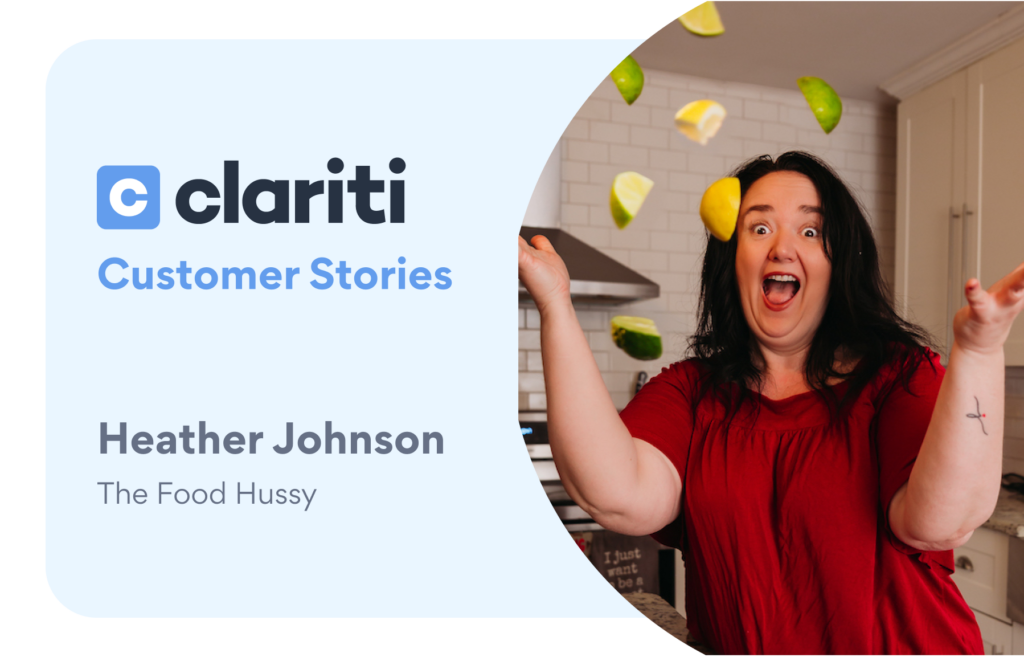
Heather Johnson has built The Food Hussy for more than a decade, grown it into a full-time business on copycat restaurant recipes, authored a cookbook, won an episode of Guy’s Grocery Games and earned a nickname to match: the Queen of Copycat Recipes. Today her site draws over 300,000 pageviews a month across a library of nearly 1,200 posts.
This is how she’s rebuilding the way she works as AI answers and shifting search change how people find recipes. She’s moving from cranking out content to prioritizing what actually matters, and using Clariti to know where to focus.
“I haven’t touched GA4 since I signed up for Clariti. Instead of trying to dig around and create reports and still not have the answers, I just pop in to Clariti and I can see how new posts are going, I can identify posts for my email plan, I can find and fix any issues on my site, I can review how keywords are working and what needs more help. It’s just easy and pretty. If there’s info I need, I can find it, and find it quickly.”
Heather’s story
In 2012, Heather was living in Cincinnati after moving from Iowa in 2004. She had a marketing job, an idea for a blog of restaurant reviews, and a name she loved before she had much else.
“Hussy is my favorite word. I’ve called my friends that for years,” she says. When a friend asked what she’d call the blog, the answer came out instantly: Food Hussy.
For a while it was a little of everything, restaurant reviews with recipes layered on top. The turning point came on vacation with another creator, who asked her the question that changed everything.
“She said, ‘Is this a job or a hobby?’ I said, ‘Well, I’d like it to be a job.’ And she bluntly said, ‘Well then, quit messing around and treat it that way.'”
So she did. Heather dropped the restaurant reviews, went all in on recipes, and blew it up. She quit her marketing job in 2023 to run The Food Hussy full time.
For most of her career, the business ran on one engine: volume. Publish relentlessly, and let the quantity compound. It worked for years. Now, with AI answers and changing search reshaping how people find recipes, Heather can feel that engine losing power.
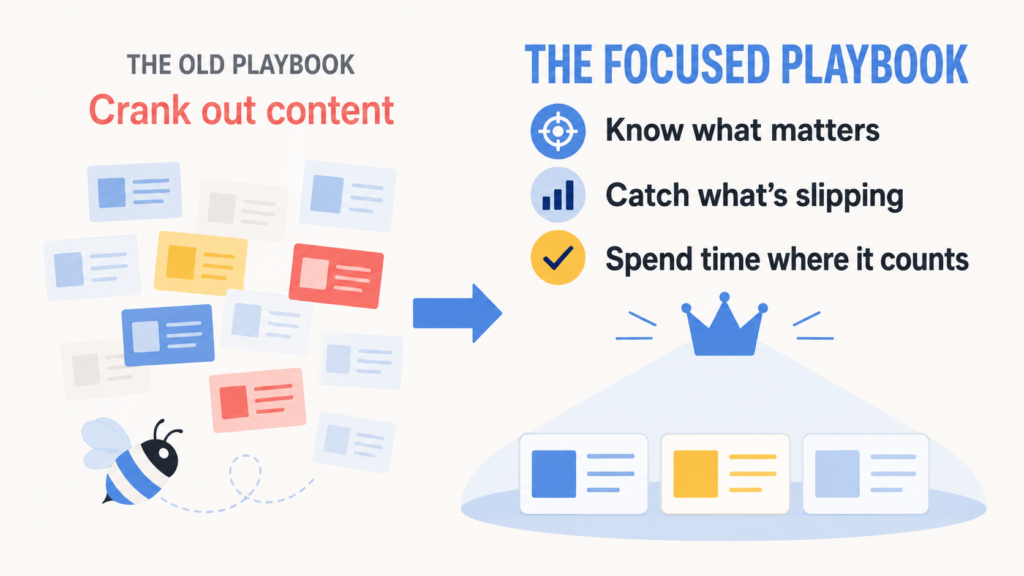
“I am comfortable being a worker bee, so that’s been how I’ve run my business. Crank. Out. Content. I’m realizing that might not sustain me going forward.”
It’s the problem a lot of seasoned creators are facing. The old playbook of more posts and more traffic doesn’t carry the same weight it used to. What comes next is focus. That means knowing which content matters, catching what’s slipping and why, seeing where readers are actually landing, and where a limited number of hours will do the most good. Here’s how Heather is making that shift.
Heather’s strategies
1. Get known for one thing
Heather still loves cooking across every appliance she owns, the Traeger, the Blackstone, the air fryer, and she built real audiences around all of them. For years she did a bit of everything, because a bit of everything worked.
Then she looked at where her traffic actually came from.
“I realized that copycat is 80 percent of my traffic, at least. I had Google juice, as I call it, from back in the day of my restaurant reviews. So I realized that was the place where I could succeed the most.”
Seeing that concentration in Clariti gave her permission to narrow. She now puts about 90 percent of her energy into copycat recipes, the corner where she has both the authority and the audience. The appliance content still performs and she still enjoys making it, but she runs the business around the thing she’s known for.
“I still love my appliances and my recipes still work great, but I’m only the QUEEN of Copycat recipes!”
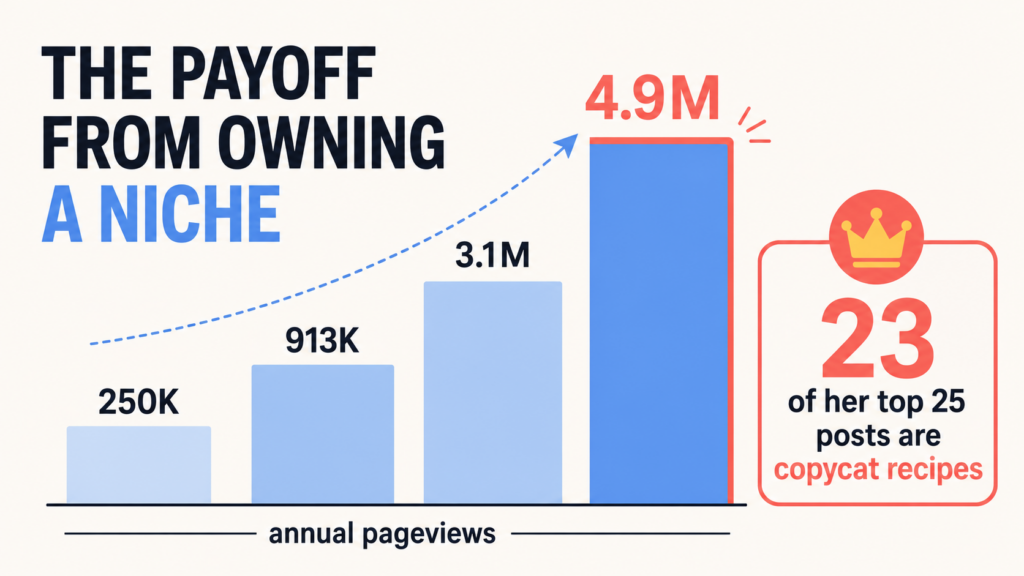
The numbers made the case. When Heather stopped doing restaurant reviews around 2019 and started leaning into recipes, annual pageviews more than tripled, from 250K to 913K in a single year. The following year they hit 3.1 million. By the time she was fully committed to copycat, they were up to 3.5 million, and they’ve stayed around 4.9 million a year ever since, even as the food-blogging landscape has gotten harder. Today, 23 of her top 25 posts are copycat recipes.
Take action: Not sure which of your posts are actually carrying the business? Here’s how to find your most valuable content in Clariti.
2. Match your posts to what people are actually searching for
Some of Heather’s best wins came from noticing where a post’s content and its readers’ actual search queries didn’t line up.
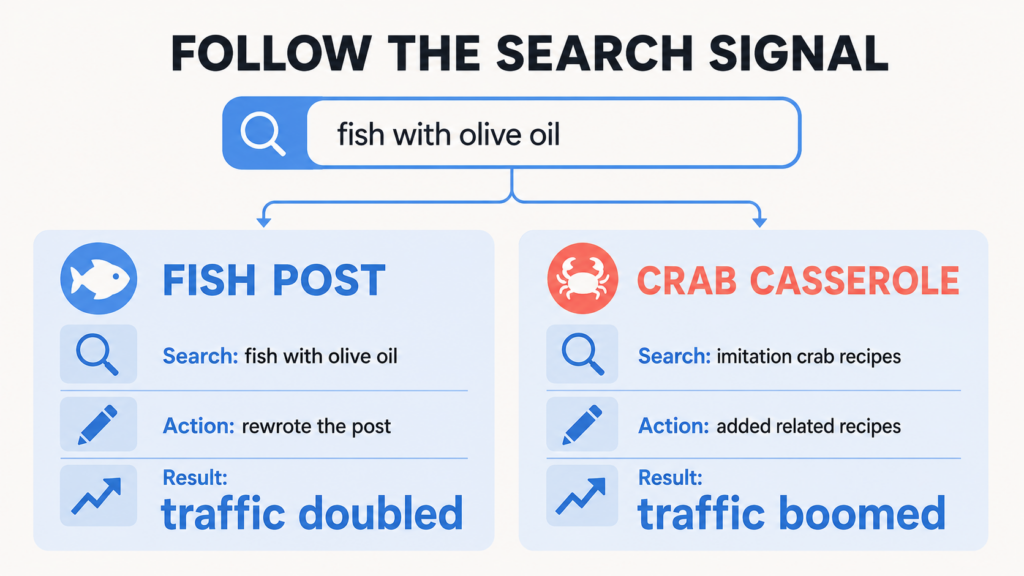
“There are a couple of instances I can think of off the top of my head where [Clariti] uncovered search terms I had no idea were being used. I had a recipe about cooking fish without oil and it was showing up in a search of cooking fish with olive oil. So I re-wrote the whole post.”
Another time, she found her Chinese buffet crab casserole was showing up for imitation crab recipes. Instead of fighting the mismatch, she added more recipes using imitation crab to meet the demand that was already there.
Those catches pay off. The fish post doubled in traffic after Heather rewrote it. The Chinese buffet crab casserole boomed after an SEO update in 2023. The imitation crab round-up is newer and still growing, but the pattern holds. When she matches a post to what readers actually want, the numbers follow.
Take action: Curious what people are actually typing to find your posts? See the keywords driving traffic to each one and spot the ones ranking for something different than you thought. You can also rank every post by how it’s performing for a specific traffic source to find untapped opportunities.
3. Catch traffic drops before they snowball
A recent trip to the Smart Influencer Summit gave Heather a new habit. She started dedicating what she calls a “CEO Day,” a regular block of time for tracking her top posts and her second-tier posts with traffic declines.
“I’m just starting a new task of looking at pages that have lost significant traffic and the ‘compare’ tool on the Performance tab was so helpful. I could click a button and see where the traffic drop came from.”
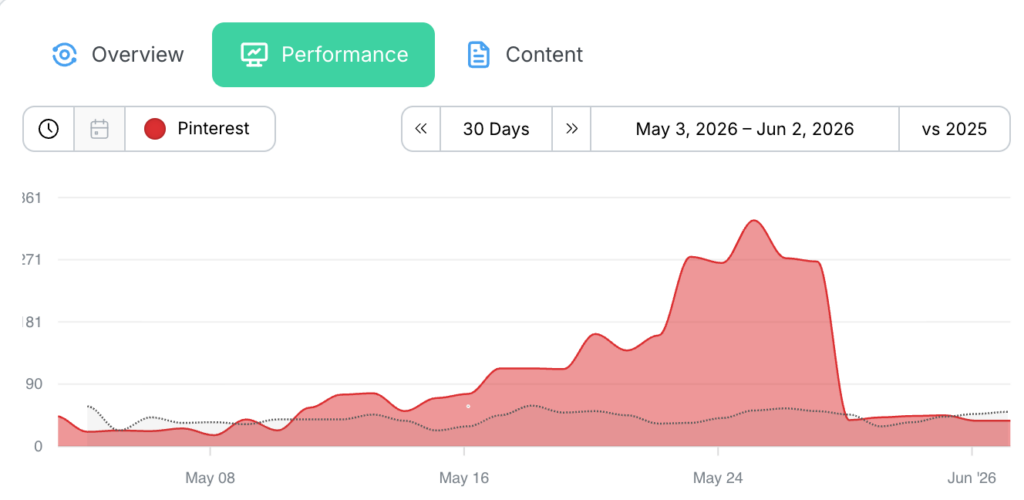
Her top posts are still holding strong. Two or three have taken hits from AI overviews, but the rest are steady. The second-tier posts, the layer just below her top ten, tell a clearer story about where the losses are coming from.
“For my 2nd tier posts, it’s ALL Pinterest. 10 out of 10.”
Once she saw the pattern, she brought in a Pinterest VA to work through the list, creating new pins for the posts that had lost traction.
Take action: Here’s what to do when your blog traffic drops, starting with how to find where the loss came from. You can also see traffic to each post by individual source to pinpoint exactly which channel slipped.
4. Turn your best content into products
Heather doesn’t think of herself as someone who makes pretty food. But her Aldi charcuterie board post came out beautifully, readers loved it, and she turned it into something they could buy.
“I recently launched my Food Hussy Charcuterie Kit to help others that struggle with that. I can whip out a board in like 20 minutes now. And it’s pretty.”
When she’s deciding what to build next, she starts with her strongest posts. Clariti shows her which ones those are. The charcuterie kit is one bet. She has also launched a product focused on her plethora of Chicken Salad Chick recipes as well as a couple of ebooks on saving money with copycat recipes.
“I think as a solo-preneur, I get spread too thin on a daily basis. Right now I’m trying to focus ONLY on things that will make me money. With that, I’ve stopped trying to get that viral video on social. I’ve thrown too much money at that with no success. I’m focused on traffic, products and email.”
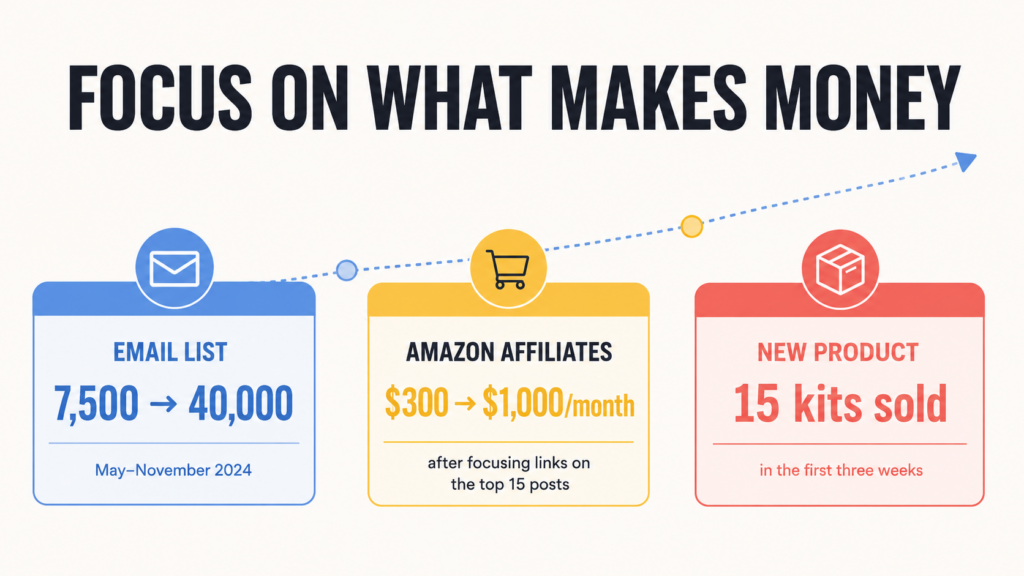
The numbers back the strategy. Between May and November 2024, Heather’s email list grew from 7,500 to 40,000 subscribers, driven by joining highly targeted Facebook groups for copycat recipes, Blackstone, and Traeger cooking. She’s still doing it, and the list is still growing. The Charcuterie Kit, which she launched in late June 2026, is newer. In its first three weeks:
“I’ve sold 15! That’s better than 0!”
The kit is part of a slower play. “It’s a slow process though because it’s email list, social media, blog posts (start with freebie and build to product), Pinterest, etc. This isn’t quick money but it could become long term.”
Amazon affiliates are one place where the focus pays off quickly. By concentrating her links on the top 15 posts, especially ones with unique ingredients like lavash bread and truffles, she’s tripled that revenue from around $300 a month to $1,000.
Take action: Learn how to find the revenue layer your content is already pointing to, and how to make your best posts do more than one job.
5. Draw a line AI doesn’t cross
Like a lot of creators, Heather ignored AI at first.
“Oye, AI. Like a lot of others, I stuck my head in the sand and tried to ignore it. Unfortunately it’s not going anywhere.”
Once she engaged with it, she got clear about where it belongs. The same summit that gave her CEO Day also pushed her to start using AI for the business side, brainstorming, planning, task management, and she’s been happy with how that’s played out so far. The craft stays hers.
“I’m keeping the recipe creation, photography and writing in the hands of this real human.”
That line is also her edge. As search fills up with generic, machine-made recipe content, the reason readers keep coming to Heather is the part she refuses to automate. It’s a real person who tested the recipe, shot the actual food, and wrote it in a voice they recognize. In the copycat niche, people don’t want a plausible guess at Olive Garden Alfredo. They want the one that works, from someone who made it.
Protecting that craft takes time, and Heather doesn’t have unlimited hours. Being able to “pop in” to Clariti and “find it quickly” is what gets her those hours back, hours she puts straight into the work only she can do.
Take action: Decide which parts of your work are the reason people come to you, and protect the time to do them by staying in the craft, guarding your attention, and keeping the human parts in human hands.
What keeps her going
Not everything shows up in the performance numbers. The strategies that keep The Food Hussy healthy, the focus, the diagnosis, the products, the discipline, are worth doing. But they aren’t the reason Heather started this, and they aren’t what she thinks about when she looks back at fourteen years.
Ask her what she’s most proud of and the answer is immediate.
“My Mom’s Peach Cobbler was my first secret success, because that literally was her recipe. She said it came through her family from the WAGON TRAIN. Good Lord. It did really well on Pinterest and the comments are just amazing on the post. It really is delicious. And people love it.”
After more than a decade, her advice to other creators skips the hype.
“In 2024, all these kids came out of the woodwork with their ‘I made six figures in six months.’ That’s not typical. It’s hard work. It’s doing this full time while working an actual full time job until it builds up to a full time income.”
What she offers instead is simpler.
“Find blogs that you like. Be realistic, not Martha. Reach out and make a new friend. Ninety-nine percent of us want to see someone else succeed. I’m an open book. I’m not all-knowing, but I know some stuff and I’m happy to help.”
That willingness to help says a lot about why she’s still here. Fourteen years in, Heather isn’t chasing the algorithm or the six-figures-in-six-months fantasy. She’s doing the less glamorous work of knowing her niche, keeping the recipes and the writing her own, and watching closely what her content is doing so she can spend her time where it counts.
The rules of search may be changing, but the Queen of Copycat Recipes still keeps her crown.
If you found this case study helpful, please support Heather by trying one of her copycat restaurant recipes, grabbing her Food Hussy Charcuterie Kit, or her Chicken Salad Party Kit.
Clariti helps food and lifestyle creators see what their content is actually doing, so they can spend their time on the work that matters most. Learn more about Clariti.

About the Author
Jen is the Associate General Manager at Clariti with a soft spot for great tech and good snacks. She has a Master’s degree in Human-Computer Interaction (which is a fancy way of saying she’s really into how people and tech get along). When she’s not working, you can usually find her hanging out with her family or baking something she’ll insist is “just a little treat.”