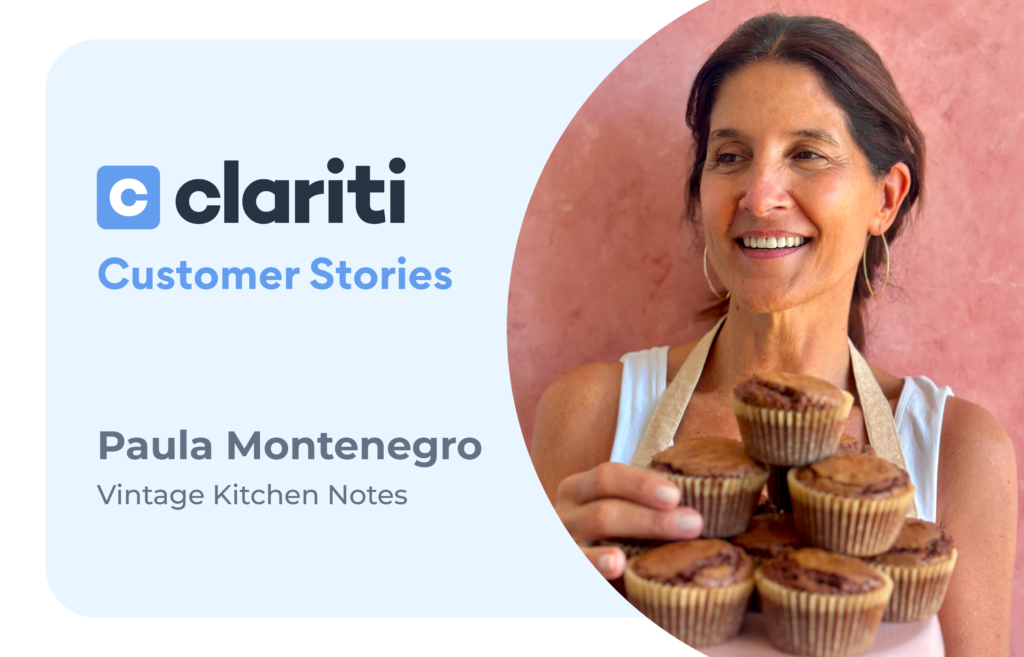
Paula Montenegro learned her first recipe at seven years old, in her grandmother’s kitchen. It was an apple crumble.
Her family didn’t cook much day to day, but her grandmother had collected every family recipe from the generations before her. That kitchen became Paula’s happy place. As a teenager, she started collecting cookbooks of her own, experimenting constantly and baking simply because she loved it.
In 2010, she opened a café with a partner. “Let’s just say it didn’t work, at all,” she says. Reading food blogs became her escape from that complicated stretch, and it showed her a world she wanted to be part of. In 2012, she started Vintage Kitchen Notes.
“It wasn’t with a grand business plan,” Paula says. “It was my way of doing something fun, that I thoroughly enjoyed.”
Today, Vintage Kitchen Notes is her full-time work, with more than 800 recipes and a 15th birthday coming up in a few months. The site focuses on vintage and old-fashioned baking from American, European and Latin American traditions, including generational recipes from Paula’s Argentinian, Italian, Spanish and Irish family. Every recipe is tested for today’s kitchens and comes with the small details that help home bakers succeed.
“My goal is for someone to bake one of my recipes and think, ‘This is going into the family recipe box.'”
Like every food creator right now, Paula is working through big changes in how people find recipes. She has seen a few of these shifts by now. In 2012, the challenge was getting a blog to look nice at all. “It was expensive, or you had to know code, or settle for Blogspot,” she says. Today it’s AI answers and changing search.
“Traffic patterns have changed, search is changing, and people are discovering recipes in completely different ways than they did even a few years ago,” she says. “That’s challenging for everyone who creates original content.”
Google still brings in almost 70% of Paula’s traffic. “That share hasn’t changed in years, but the volume has,” she says. Her response has been to put more into the things that have always made Vintage Kitchen Notes worth visiting: carefully tested recipes, the stories behind them, and a library she keeps improving. Here’s how she’s approaching it.
Paula’s strategies

1. Share recipes people will still be baking in 20 years
Paula doesn’t publish a recipe because it’s trending. Before anything goes on the site, she asks a simple question.
“I ask whether it’s a recipe someone will still be baking ten or twenty years from now,” she says. “Those are the recipes I’m most interested in sharing.”
That belief came from the baking itself. The more vintage recipes she made, the more she noticed how reliable they were. Many were created to be made week after week with ingredients people already had in the pantry.
“They weren’t chasing trends,” she says.
Readers are looking for them too. “If you look at volume searches online, you’ll see that the highest ones are classic and old-fashioned recipes for the most part,” Paula says.
Old recipes usually need some work before they’re ready for today’s kitchens. Ovens, pans and ingredients have all changed, and so have expectations. Paula might find a recipe in a 1940s community cookbook and spend weeks getting it right. Right now she’s testing a Marlborough pie, an old apple pie made with grated fruit and a custard filling.
“I’ve yet to find the right balance of sweetness and apple flavor,” she says. “I’m confident I’ll get there, but sometimes they don’t work, and I move on.”
2. Lean into what only a real baker can do
Paula sees AI as a big shift, and also as something that makes real baking experience more valuable.
“AI can’t spend an afternoon testing three versions of a fruit crumble to figure out why one crumb topping browns better than another,” she says. “It can’t answer reader questions from years of actually baking.”
So she’s putting her energy into the parts of the work that come from three decades in the kitchen.
“Instead of trying to compete with technology, I’m leaning into the things only a real baker can provide: testing, context, troubleshooting, and trust.”
She does use AI, mostly for admin and back-end work. The recipes, the testing and the answers to readers stay with her.
Her perspective is part of what readers can’t find anywhere else. Living in Argentina while writing mostly for American readers, Paula was writing about dulce de leche and chimichurri when the blog launched, before most of her readers had heard of either. Introducing readers to new recipes and telling the stories behind familiar ones is what keeps the work fresh for her. She hopes it adds something valuable for readers too.
3. Improve what you’ve already made
With more than 800 recipes on the site, Paula knows how easy it is to lose track of where the biggest opportunities are. Clariti is how she keeps the whole library in view.
“I open it every day I work on my blog,” she says. “I don’t use the search function in my blog anymore; I use Clariti.”
She uses it to find posts that need more internal links and to pull up related recipes in seconds. Labels, notes and the timeline of every change a post has had help her keep track of every detail across the site.
“It’s like my personal VA for admin work when it comes to every detail about every single recipe I have posted,” she says.
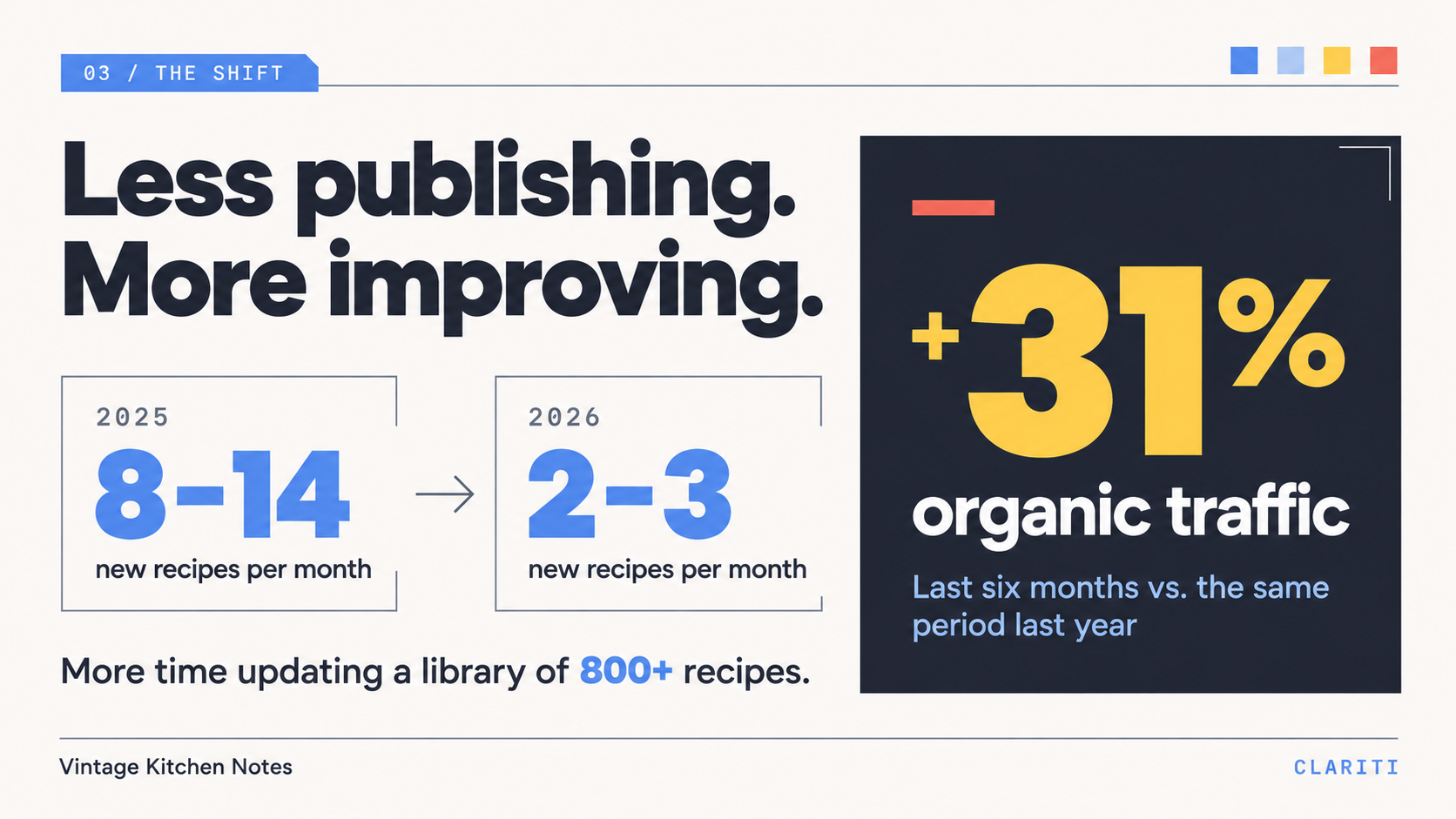
That view changed how Paula spends her time. She went from publishing 8 to 14 new recipes a month in 2025 to two or three a month in 2026, and she now spends most of her time updating the ones she already has. She expected AI Overviews to make 2026 a hard year for organic traffic.
“To my surprise, my organic traffic grew quite a bit, which I was not expecting,” she says. “It’s up 31% in the last six months compared to last year. The climb started about four months into focusing on updates, around the May Google core update. It’s really paying off, especially with Q4 here.”
The updates go beyond technical fixes. Paula regularly goes back to her own recipes from 10 or 15 years ago because she’s a better baker now. Those older posts often already have years of reader trust behind them.
“Some of my best-performing recipes today aren’t the newest ones,” she says. “They’re the ones I’ve continued to refine over the years.”

4. Find out why a post dropped before you change it
When a recipe loses traffic, it’s tempting to start rewriting it right away. Paula has learned to check where the drop came from first.
“When traffic to a post drops, my first instinct is to blame Google and start thinking about SEO,” she says. “Clariti lets me quickly see which platform is actually responsible for the decline.”
That happened recently with her oatmeal muffins. Traffic to the post was down 41% in 2026 compared to last year. The Source view on Clariti’s Performance dashboard showed the drop was coming from Pinterest, which was down 54%. Organic search was up 47%. With search growing, rewriting the post could have done more harm than good. Paula left it alone and focused on the pins instead.
“Being able to spot that so quickly was a godsend,” she says.

For Paula, knowing which posts to leave alone matters as much as knowing which ones to fix. She finds GA4 hard to understand in depth, so Clariti’s Performance graph has become her go-to for that data.
“It’s easy to quickly spot posts that are losing traffic or, just as important, those that should not be touched,” she says.
5. Pick a few places and go deep
Paula doesn’t try to be on every platform. Each year she chooses three main areas to focus on and adds one or two new things to try. Her data decides which ones.
“Where is my time best spent? Which platforms make more sense to dedicate my time to?” she says. “I’d rather have a smaller audience that comes back every week than constantly chase the next algorithm.”
Her newsletter has become one of her favorite parts of the business because it’s a direct conversation with readers. Every year, she surveys her subscribers about what they want, what they need help with and how valuable the newsletter is to them. Then she adjusts.
“It’s been eye-opening,” she says. She has around 22,000 subscribers, with open rates between 50% and 55% and click rates between 3% and 4%, depending on the type of newsletter.

Video is her longer-term bet. It’s too early to tell what it’s driving, but it shows baking techniques that are hard to explain in words.
“I’m pretty sure it’s the future of content,” she says, “so even if it’s not driving a lot of traffic or revenue right now, it will never be time badly spent.”
She’s been adding video to her recipe cards, so more posts now have a “Jump to video” button at the top. “I can’t say for sure, but I wouldn’t be surprised if that helped boost Google traffic,” she says. “It’s valuable for readers who want it.”
What keeps her going
Paula’s grandmother collected every family recipe she could find. Paula has become that collector too.
“The amount of old recipe clippings (yes, I’m vintage), old and new cookbooks and handwritten recipes I have is staggering,” she says. “And it keeps growing.”
She still loves the moment an old recipe turns out exactly as good as she hoped. For her, the recipes are worth more than nostalgia.
“Food is one of the easiest ways to preserve history,” Paula says. “A handwritten recipe card or an old family cake tells you something about the people who came before you that no photograph really can.”
She thinks those recipes should keep being baked, not just talked about. Adapted thoughtfully for today’s kitchens, they’re often simpler than people expect, less wasteful, and full of techniques that have lasted because they work.
The tools behind the blog have changed many times since 2012. When we surveyed Clariti customers earlier this year, Paula told us which one she’d hold on to: “If I only had to keep one paid tool, it would be Clariti.”
Her advice to other creators starts with building around something you genuinely care about.
“It’s easy to chase what’s popular, but that’s exhausting if it doesn’t align with what you love,” she says. “I think people eventually recognize genuine expertise and consistency.”
And then, she says, remember what you’re really building.
“Chase community, not traffic. If readers know your recipes work, they’ll come back and talk about them to someone else.”

That’s how a recipe makes it into the family recipe box. It stops being “one I found online” and becomes “the one we always make.”
If you found this customer story helpful, please support Paula by baking one of her vintage and heirloom recipes or signing up for the Vintage Kitchen Notes newsletter.

About the Author
Jen is the Associate General Manager at Clariti with a soft spot for great tech and good snacks. She has a Master’s degree in Human-Computer Interaction (which is a fancy way of saying she’s really into how people and tech get along). When she’s not working, you can usually find her hanging out with her family or baking something she’ll insist is “just a little treat.”